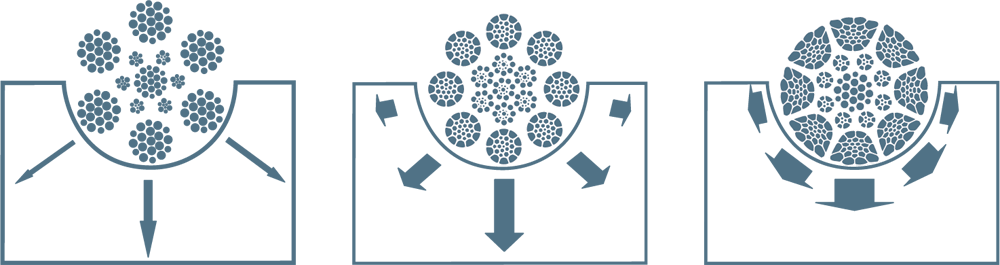
Changes in line pull will cause changes in the rope length. Rope sections lying on a sheave or on the first wraps of a drum can only adapt to the changing line pull by sliding over the groove surface of the sheave or the drum when the length change occurs.
This relative motion will cause abrasion (both in the grooves and on the special wire rope). Using less and therefore larger outer wires can increase the wear resistance of the rope. The pressure between the sheave and the rope can be minimized due to optimized contact areas; therefore also the wear of the rope can be minimized. The wear resistance can also be influenced by the metallurgy of the outer strands.
General Wear Resistance Characteristics by strand design:
Point-contact wire rope like 6x19M: Wires primarily make point contact with one another. Under load, this tends to cause indentations and stress concentrations, resulting in moderate wear resistance and fatigue life.
Line-contact wire rope like 6x19S: Wires between layers make parallel (line) contact. This reduces contact stress, leading to superior wear resistance and fatigue performance.
Compacted-strand wire rope like 6xK19S: Wires within each strand make surface-to-surface contact, creating a smoother exterior. This increases the contact area with drums and sheaves, typically resulting in significantly better wear resistance than standard round-strand ropes—often reported to be approximately twice as durable.
Rotary swaged wire rope like K6x19S: Offer the highest level of wear resistance.